
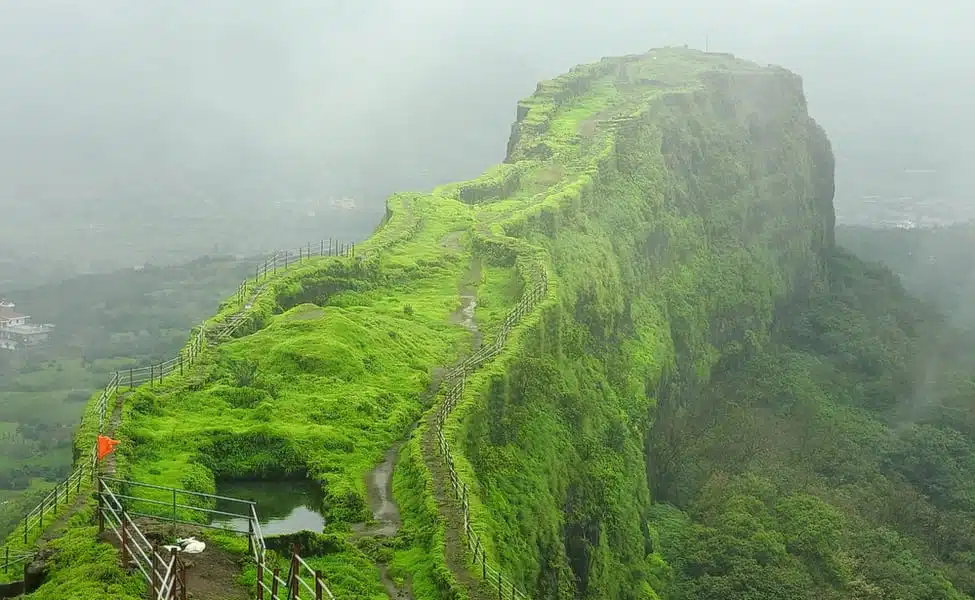
Echoing the resilience, bravery, and architectural radiance, Lohgad Fort is a timeless historical representation of the rich history of India. Nestled amidst the magnificent Sahyadri Mountains, this Fort speaks volume about the richness and depth of Indian history. The “Iron Fort”, which is a literal translation of Lohgad in the Marathi language, has recently been emblazoned as a UNESCO World Heritage Site. This recognition highlights its historical importance but also encourages its preservation for future generations as it is aware of the rich history we have.
A Fortress Forged in Iron and History
The Lohgad fort is situated at an altitude of 1,033 meters above sea level. The fort has witnessed historical events including constant battles, political upheavals and royal administrations. As per the historical records, this fort has its origin back in the 1st or 2nd century BCE and it is during the administration of the Satavahanas. It is also mentioned that the fort was under several dynasties such as Yadavas, Mughals, Chalukyas, Rashtrakutas controlled the operations at the fort. Ultimately, the Marathas overtook the charge of the Lohgad Fort.
Chhatrapati Shivaji Maharaj captured the fort in 1648, and the fort gained immense prominence then. The fort is situated between the Konkan coast and the Deccan plateau, which served as a protective link for trade routes. The fort was also used to keep an eye on the enemy movements. Chhatrapati Shivaji Maharaj recognized the strategic magnitude of the fort and later used it to store his assets.
Architectural Magnificence Amidst Natural Finery
Lohgad ’s construction is a spectacular illustration of medieval Indian military architecture. The fort stretches over a massive ridge, linking it to the adjoining Visapur Fort. Its four gigantic gates—Ganesh Darwaja, Narayan Darwaja, Hanuman Darwaja, and Maha Darwaja—are masterpieces in themselves, imprinted with obscure carvings and equipped with hearty stonework.
One of the most iconic features of Lohgad is the Vinchukata or “Scorpion’s Tail”—a long, narrow expansion of the fort that bears a resemblance to the stinger of a scorpion when observed from above. This natural feature offered a strong defensive benefit and an exceptional vantage point for inspection.
The views from the top of the Lohgad Fort are breathtaking and can be discussed days after you visited the fort. Clearer days call for watching the shimmering waters of the Pawna Lake, green hills of Lonavala, and the adjoining forts of Tung and Tikona. People visiting Pawna Lake camping and luxury resorts must visit Lohgad Fort. The whole region becomes a heaven with picturesque green landscapes and playful waterfalls falling down the hills with force and vivacity.
Pawna Lake Camping visitors should not miss out on the opportunity to visit Lohgad Fort for its historical significance, and its latest addition to the World Heritage Site list.
Inclusion in the World Heritage Site List
In 2025, Lohgad Fort received a prestigious honor: it was inscribed as a UNESCO World Heritage Site under the cultural category for its outstanding universal value. The inclusion was part of a broader recognition of the “Hill Forts of the Deccan Plateau,” joining the likes of Rajasthan’s hill forts and Maharashtra’s rock-cut wonders.
The UNESCO committee highlighted several aspects in granting this status:
Historical Significance: Its strategic role during the Maratha Empire, especially under Chhatrapati Shivaji Maharaj, made it a pivotal military base.
Architectural Excellence: The fort’s defensive planning, use of natural terrain, and gateway designs showcased early Indian engineering prowess.
Cultural Integrity: Despite centuries of change, Lohgad retains much of its original structure, layout, and spiritual significance.
Environmental Harmony: The fort blends seamlessly with the surrounding Sahyadri landscape, exemplifying the ancient Indian philosophy of living in harmony with nature.
This designation brings with it not only recognition but also a promise of preservation, improved visitor facilities, and sustainable tourism.
A Trekker’s Delight and a Historian’s Treasure
Today, Lohgad Fort is one of the most popular trekking destinations in Maharashtra. The moderate trek from the base village of Malavli takes around 1.5 to 2 hours, winding through shaded forest paths, ancient steps, and moss-laden rocks. It’s particularly admired during the monsoon period when the trail is surrounded by a flourishing green awning and mischievous streams.
For history buffs, Lohgad offers more than just panoramic views. The remnants of old cannons, granaries, and water cisterns offer a glimpse into the fort’s past life. The Buddhist caves at the foothills, believed to be over 2,000 years old, further add to its archaeological richness.
Preserving the Legacy
The recognition by UNESCO has prompted state and central governments to invest more in conservation efforts. Steps are being taken to:
- Restore eroded structures and pathways without compromising authenticity.
- Control unregulated tourist footfall to avoid environmental degradation.
- Promote guided heritage walks and educational programs.
- Involve local communities in preservation and tourism efforts, ensuring that development is both sustainable and inclusive.